



- Radar-like tech, resembling echolocation used by bats, can ‘sense’ everyday items and biological objects and link them with the online world.
- Test results shown on Tiami Networks stand (6F7) Mobile World Congress (MWC26), 3-5 March 2026
Imagine standing on a busy train platform, and your phone alerts you that the crowd is getting dangerously big. Or use your smartphone to detect a burst water pipe hidden within the walls of your home. Or shopping malls counting visitor volumes without using cameras, keeping your privacy safe.
Vodafone and Tiami Networks are testing a new technology called Integrated Sensing and Communication (ISAC) which in the future could do just that, transforming today’s mobile networks into high precision, smart sensors.
To the Batphone
ISAC uses echo radar-like features that enable 5G networks to “sense and visualise” unconnected objects in much the same way as bats use echolocation to fly and hunt in the dark. This means your phone could warn you about dangerous situations, like crowded spaces, or help airports and industrial facilities detect intruders or unauthorised drones. The potential applications for ISAC are vast. It is also expected to monitor natural disasters, track livestock, enable 3D mapping via smart glasses, detect contaminated food, help robots understand human hand commands, and even locate misplaced house keys.
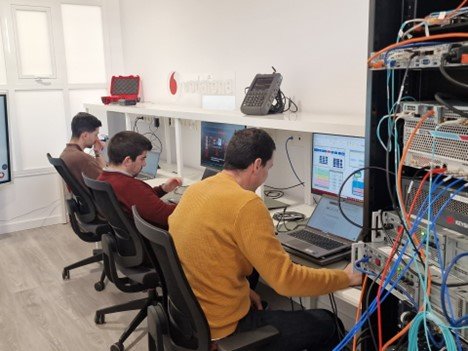
While ISAC is considered an essential component of future software-driven 6G networks which are expected to be operational around 2030, Vodafone and Tiami have demonstrated that it can also operate with current mobile spectrum, base stations, and smartphones. At Vodafone’s R&D lab in Malaga, Spain, the companies used Tiami Network’s distributed application, PolyRAN – which transforms base stations into wide-area sensors – to successfully detect unconnected objects, including colleagues, across a 5G network.
Marco Zangani, Director of Network Strategy and Architecture, Vodafone, said: “Our 6G-ready test shows that your phone could soon do a lot more than connect you. It could be used to help keep you safe wherever you go.”
Detect Intruders
Significantly, the Vodafone–Tiami Networks proof-of-concept demonstrated that current networks could detect objects using radio waves without interfering with calls, messages, or internet connectivity.
Vodafone also used Open RAN compliant radio antennas to show how hardware and software from different vendors could be used, supporting a wider partner ecosystem. Swapping in new software supports the evolution of AI-on-RAN, which aims to transform base stations from connectivity-only providers to advanced edge computing platforms.
“Our vision for PolyRAN is simple. Deploying ISAC should be as seamless as enabling a software application within a 5G network without disrupting existing connectivity services. Testing with Vodafone allows us to evaluate realistic performance and deployment pathways with a leading operator that is deeply engaged in 6G research,” added Amitav Mukherjee, CEO and Founder of Tiami Networks.
Shaping 6G standards
This latest initiative underlines the importance of Vodafone’s Málaga R&D Center as a leading AI-RAN innovation hub, closely connected to Open RAN chip development and future 5G Advanced and 6G network capabilities. As a major European Open RAN research site, Málaga plays a key role in advancing intelligent, software-driven RAN functions across Vodafone’s markets.
The industry standards group 3GPP, with input from Vodafone, is defining ISAC in its Release 19, and this technology is expected to be a key feature of 6G. Collaborative efforts such as the one between Vodafone and Tiami Networks offer practical insights for network-enabled sensing, with both companies committed to continued testing focused on performance and AI-RAN models through 2026.
More stories



Vodafone launches Express Capacity to quickly meet demand for data centre connectivity
3 minute read