Share price

24 July 2025

Q1 FY26 update

2.25c to be paid August 01, 2025

Final Dividend FY25

Capital allocation principles

In March 2024, we conducted a broad capital allocation review, considering the Group's strategy within its reshaped footprint. This review has concluded the following key outcomes:

  • Investment: Following an extensive review of our capital investment requirements, the current capital intensity will be broadly maintained at a market level, which will allow for appropriate investment in networks and growth opportunities.
  • Leverage: A new leverage policy of 2.25x – 2.75x Net Debt to Adjusted EBITDAaL and we target to operate within the bottom half of this range. The leverage policy supports a solid investment grade credit rating and positions Vodafone to continue to invest for growth over the long-term.
  • Shareholder returns (dividends): The Board determined to adopt a new rebased dividend from FY25 onwards. The Board has declared total dividends of 4.5 eurocents per share for FY25 with an ambition to grow it over time.
  • Shareholder returns (share buybacks): During FY25, the Board approved a capital return through share buybacks of up to €2.0 billion of the proceeds from the sale of Vodafone Spain. A new share buyback programme of up to €2.0 billion of the proceeds from the sale of Vodafone Italy has started, with the first €500 million tranche commencing on 20 May 2025. Total capital returns to shareholders in FY25 
were €3.7 billion.

The Group's policy is to borrow centrally across a diversified selection of currencies using predominantly medium and long-term capital market issues.

In respect of certain emerging markets, we may elect to borrow on a non-recourse basis.

Our mid to long-term debt is primarily financed via corporate bond programmes. Any short-term funding requirements are met through our commercial paper programme.

We have three bond programmes to meet our medium to long-term funding requirements; two €30 billion euro medium-term note (EMTN) programmes and a US shelf programme.

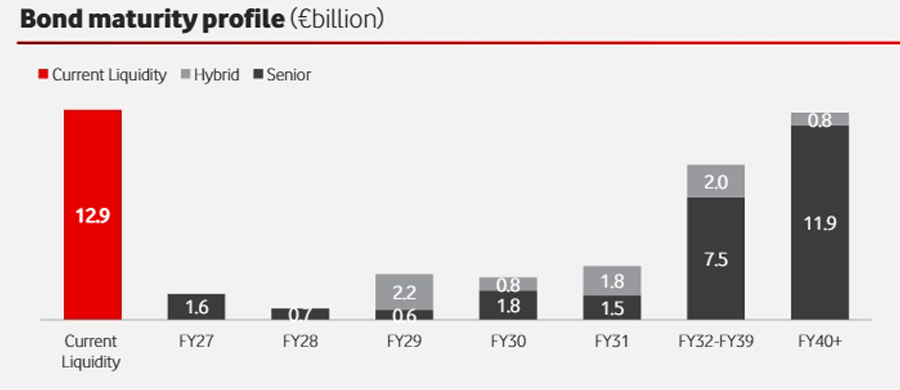
Bond maturity profile

Hybrid bonds
The bond maturity profile includes hybrid securities, the key features of which are:

  • Legal maturity of at least 30 years but are callable between FY29 and FY51.
  • Attract 50% equity treatment from all three major credit rating agencies (Moody’s, S&P and Fitch).
  • A permanent part of our capital structure.
  • Treated at 100% debt in our accounts and net debt to adjusted EBITDaL calculation.

We have three bond programmes to meet our medium to long-term funding requirements; two €30 billion euro medium-term note (EMTN) programmes and a US shelf programme.

As part of its commitment to sustainability, Vodafone Group Plc has designed a Sustainable and Sustainability-linked Framework (the ‘Framework’) under which Vodafone can issue green, social, sustainability and sustainability-linked funding instruments to finance or refinance projects enabling the company to meet its environmental and/or social objectives. This Framework replaces Vodafone’s Green Bond Framework which was published in August 2018.

The latest Framework, published in September 2021, sets out what projects are eligible under the use of proceeds, the process for project evaluation and selection, the management of proceeds, and reporting. The Framework also sets out our new sustainability-linked finance framework, which covers key performance indicators, sustainability performance targets, the characteristics of financing instruments, reporting, and verification.

Sustainalytics, a provider of environmental, social and governance (ESG) research and analysis, has provided a second-party opinion on Vodafone’s Framework. Sustainalytics is of the opinion that the Framework is credible, impactful and aligns with International Capital Markets Association relevant principles. In Sustainalytics’ opinion, the strength of our selected key performance indicators is also strong or very strong and our targets are ambitious or highly ambitious.

In May 2020, Vodafone released its first Green Bond Report detailing how funds raised in accordance with Green Bond Framework had been fully allocated and the associated impact. Subject to issuance of applicable funding instruments, Vodafone will continue to report on the allocation of proceeds and the associated impact in the year(s) following issuance of any future funding instruments under the current Framework.

Sustainability Framework (FY22)

Sustainalytics Second Party Opinion (FY22)

Vodafone Green Bond Framework (FY19)

Sustainalytics Second Party Opinion (FY19)

Vodafone Green Bond Report (FY20)

Maintaining leverage at the lower half of our 2.25-2.75x net debt to adjusted EBITDaL range is one of our three capital allocation priorities.

The other two priorities are:

  1. Invest appropriately in the business
  2. Provide an attractive return to shareholders

Vodafone maintains credit ratings with the three most prominent international credit rating agencies.

Vodafone’s current credit rating and outlook is included in the table below.

Rating agency Short termLong termOutlook
Moody'sP-2Baa2Stable
FitchF-2BBBPositive
Standard and Poor'sA-2BBBStable

The current position is consistent with our intention to maintain a solid investment grade rating.

Vodafone operates with a centralised Treasury function so that key Treasury risks are managed at a Group level.

Liquidity
Prudent level of available cash and unutilised credit facilities which cover near term bond maturities and cash requirements.
Bond maturities are limited in any one financial year to minimise refinancing risk.
Cash is centralised with Group Treasury wherever possible.
The Group maintains two Revolving Credit Facilities which provide backstop liquidity, US$4bn maturing March 2028 & €4bn maturing Feb 2030.

Investment
Investments are focused on short dated and highly liquid instruments. Security and preservation of capital are the priorities.

Foreign Exchange
Majority of debt is held in Euro, being the functional currency of the Group and representing the vast majority of the Group’s assets. Some debt is held in South African Rand to hedge the Group’s Vodacom asset. Bonds which are issued in currencies other than Euro are hedged into Euro using cross currency interest rate swap derivatives. Transactional currency exposures substantially hedged.

Credit Risk
All derivatives are executed with high investment grade financial institutions, the majority of which are Globally Systemically Important Institutions (as defined by the Financial Stability Board) Derivative positions are all collateralised by the banking counterparty

Interest Rate
All bond debt is held on a fixed rate basis.