In disaster response, connectivity is often described as a lifeline. But for those on the ground, it is also how people know help has arrived. When a signal comes back on, families can reconnect, responders can coordinate care, and communities can take their first steps toward recovery. In those moments, connectivity becomes empathy in action, carried across a global network built for when people need it most.
On a recent mission in Jamaica, a church that had stood for almost two centuries came into view. Brick-built and familiar, it had long been a fixed point in the community. Now, it had been torn apart, reduced to rubble by floodwaters and wind. Standing in front of what remained, Paul Poulain struggled to process what he was seeing.
“It was one of the first sights we saw,” he recalls. “All that was left was the tower.”
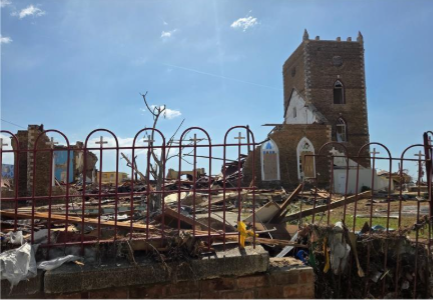
St. John Anglican, Black River, St Elizabeth, Jamaica.
Moments like this strip everything back to what really matters. When disaster strikes, it doesn’t just damage buildings or roads, it isolates people completely – cutting them off from loved ones, emergency services and the information they need to survive and recover.
This is when connectivity reveals its true purpose. It stretches from seabed to stars, quietly underpinning everyday life – but is only truly felt when it disappears.
For the volunteers of Vodafone Foundation’s Instant Network Emergency Response (INER) programme, that absence demands action. Stepping into places where normality has been violently interrupted, they help restore the connections communities need to move from shock towards recovery.
We spoke to three INER volunteers who have taken part in missions across Turkey, Mozambique and Jamaica to hear their first-hand experiences.
Turkey: when destruction becomes real
Ricardo Alves, a Programme and Project Manager based in Portugal, was part of the team deployed after the devastating earthquakes in 2023. The journey into the affected region was long, and with every mile the scale of destruction became harder to ignore. “You start seeing cracks in the road,” he says. “Buildings destroyed. And it just gets worse and worse.”
Entire neighbourhoods had collapsed. Homes, once safe, ordinary places, were reduced to piles of concrete and twisted metal. “It’s difficult to even understand that it’s real,” Ricardo admits. “It’s a dystopian scenario.”
In those moments, INER volunteers focus on restoring connectivity while operating far outside their normal day‑to‑day. They are present in places where normality has been suddenly torn away, standing alongside communities as people try to make sense of loss on an overwhelming scale.
At the same time, connectivity becomes the foundation for everything that follows. When coordination is fractured and trust in what’s happening on the ground is fragile, access to accurate, timely information is the first critical need.
The Vodafone Foundation Instant Network has been built for these moments - a portable network that travels with emergency responders and can be activated within minutes of reaching the scene.
“You need information before you can do anything else,” Ricardo explains. “There’s so much you don’t know at the start. Having reliable information allows response efforts to begin.”
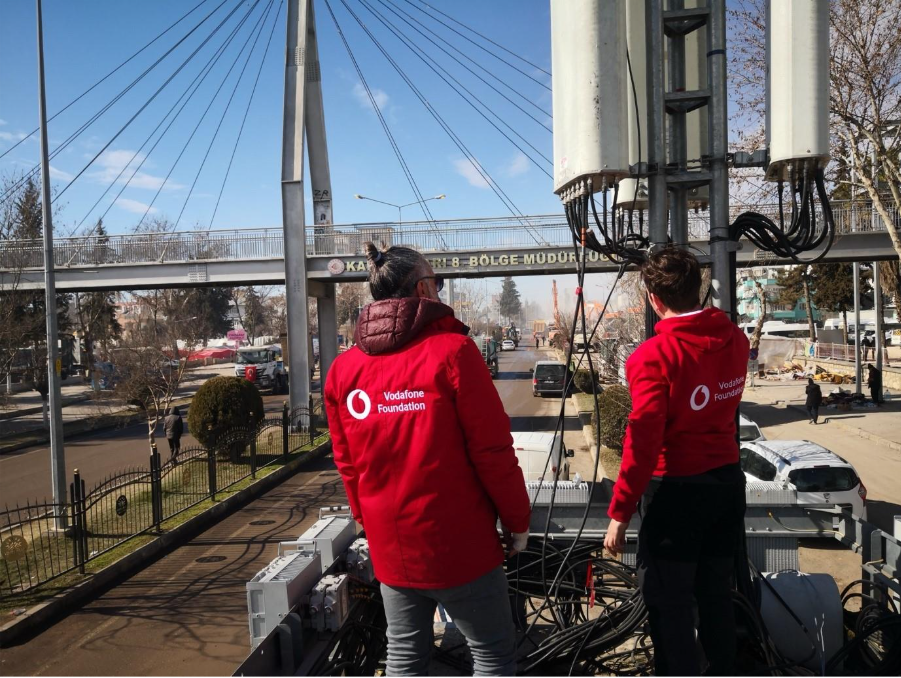
Ricardo and another INER volunteer setting up free WiFi at a government and disaster response centre in Adiyaman.
For the people affected, that connection matters just as deeply.
“It’s about being able to call loved ones,” he adds. “To say you’re safe. Or to ask for help. It’s the first step back towards life continuing.”
Mozambique: hope after silence
In Mozambique earlier this year, the devastation took a different form. Flooding had forced families from their homes, pushing them into temporary shelters. When Mayara Matsinhe Cossa, a Legal Advisor at Vodacom Mozambique, arrived for her first INER mission, the emotional impact was immediate.
“It was emotion and adrenaline at the same time,” she recalls. “There was a lot of uncertainty. But also, a strong sense of purpose: this is what I’m here to do.”
What she saw has stayed with her. Mothers carrying children. Families clutching the few belongings they had managed to save. “Their faces were exhausted,” she says. “But at the same time, I could see resilience.”
At first, the community watched the INER team cautiously. Strangers arriving in the aftermath of disaster often raise questions: Why are they here? What can they really do?
That changed when connectivity was in place and trust started to build. Using Vodafone Foundation’s Instant WiFi solution, the team was able to create secure connectivity hubs within minutes.
“When we finally had the connection, people started smiling,” Mayara says. “The atmosphere changed.”
For her, one moment captured the true impact of the work. A woman sat quietly in the shelter, overwhelmed and withdrawn. She hadn’t heard from someone she loved since the flooding began. When Mayara helped her connect, the response was immediate.
“She said, ‘Thank you so much,’” Mayara remembers. “And that thank you wasn’t just for me. It was for everyone there.”
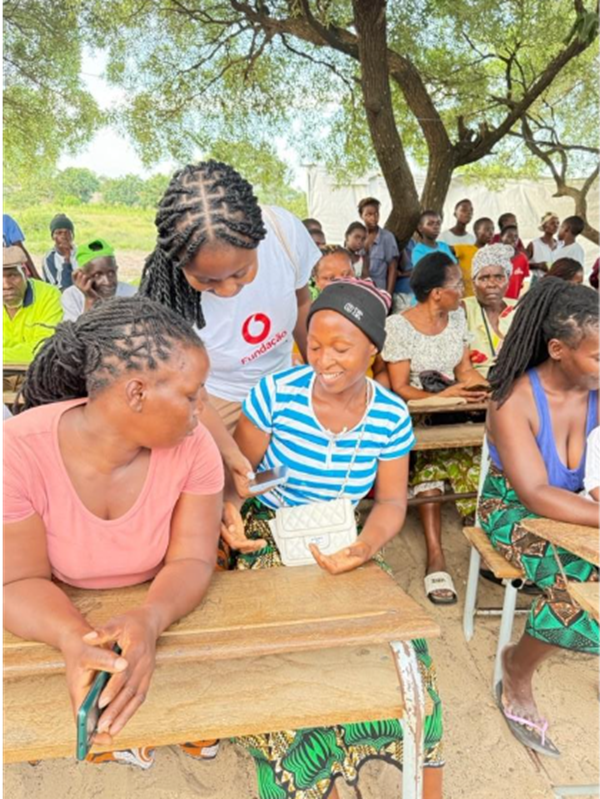
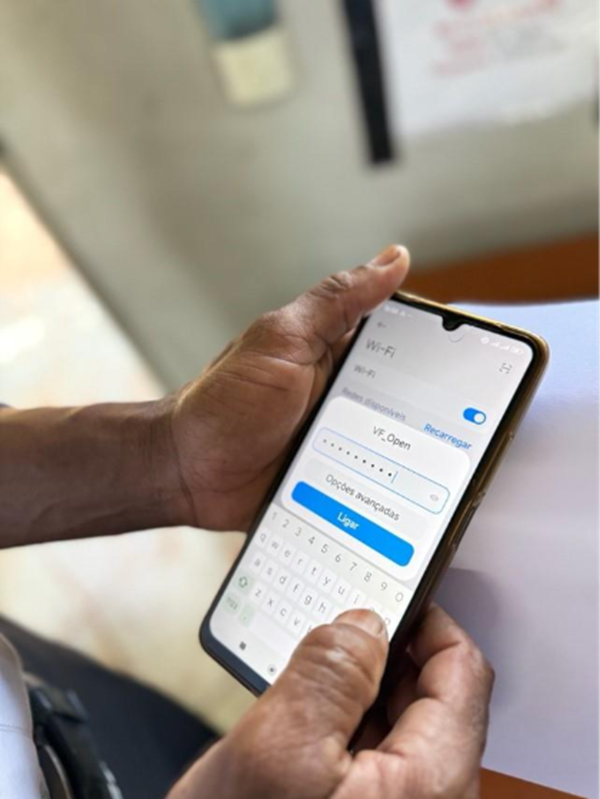
Mayara showing members of the community how to connect to the internet.
In that moment, connectivity became more than a technical solution. It was hope after silence - a reminder that even in crisis, people are not alone.
Jamaica: rebuilding systems, restoring routine
In Jamaica, following a Category 5 hurricane in late 2025, the need was both urgent and complex. Floodwaters and 185 mph winds had surged through towns and villages, leaving behind widespread damage. Roads were blocked, power lines were down, and entire communities were cut off.
Paul, a Principal Engineer at VodafoneThree, and his fellow volunteers moved between fire stations, hospitals and schools being used as emergency shelters, setting up connectivity hubs wherever they were needed most. In one fire station, a whiteboard still bore a shoulder-height mark showing how far the floodwater had reached inside the building.
“That line stays with you,” Paul says. “It makes the scale of it real.”
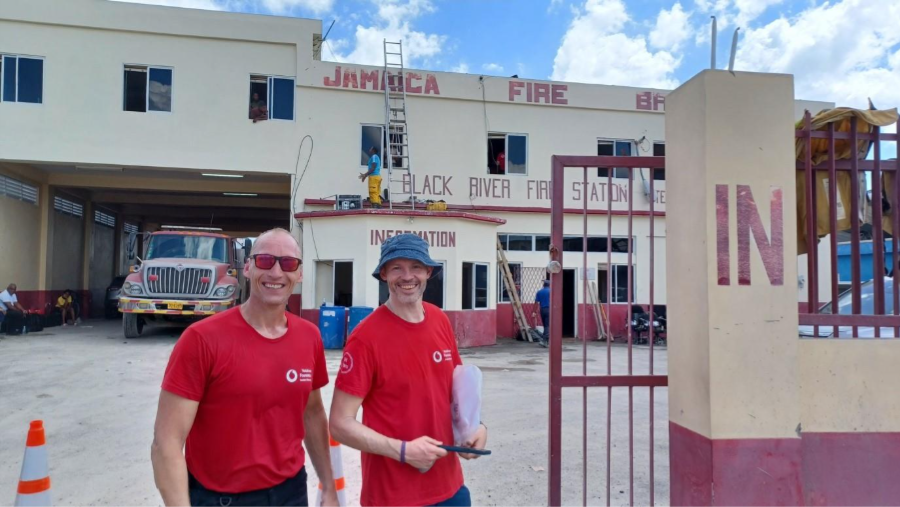
Paul and fellow INER volunteer Chris outside Black River Fire Station, where storm surge water reached the top of the gate, installing Vodafone Free WiFi for the community.
Connectivity quickly became a focal point, but another critical need soon emerged: power. Vodafone Foundation’s Instant Charge units allowed dozens of phones to be charged at once, helping people stay connected without queues, conflict or crowding in already tense environments.
People gathered to charge phones. Vans became mobile hubs, surrounded by residents desperate to contact family, access information or simply let someone know they were safe.
At one school, the team finished an installation just as dusk fell. Within minutes, dozens of people arrived. “Fifty or sixty people came out of nowhere,” Paul recalls. “Just to connect.”
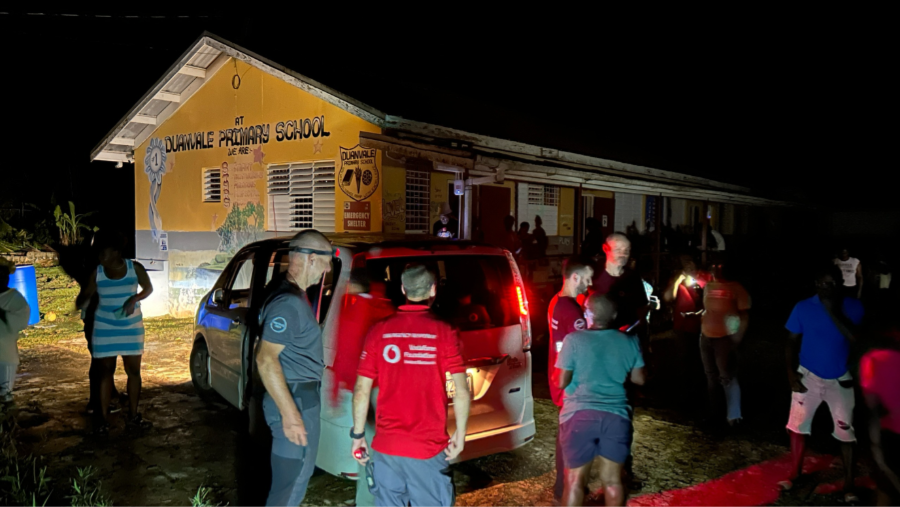
Duanvale Primary School in Jamaica after internet service was restored
In another town, traffic built up as word spread that free WiFi was available. The signal wasn’t just restoring communication; it was restoring routine. Schools reopened as community hubs. Doctors arrived and set up makeshift clinics.
Small acts made a difference too. Charging cables quietly handed over. Signs put up in the street. Mobile dongles left behind when kits had to be redeployed elsewhere. These details mattered.
So did the relationships built along the way. One local taxi driver, Andy, became an unexpected ally, helping spread the word and stepping in when others tried to take advantage. “These people have come to help us,” he told a local vendor. Later, he proudly wore a Vodafone Foundation T‑shirt and fixed a sticker to his van.
Connectivity does not rebuild homes. It does not erase trauma or undo loss. But it makes the first steps towards recovery possible.
A message finally sent. A school able to reopen. A doctor able to coordinate care. A family reassured that their loved ones are safe. In moments like these, connection brings possibility, dignity, trust and hope - and that can make all the difference.
Want to know more?
More stories
m-mama reaches 250,000 lifesaving emergency transports for pregnant women and newborns
0 minute read