


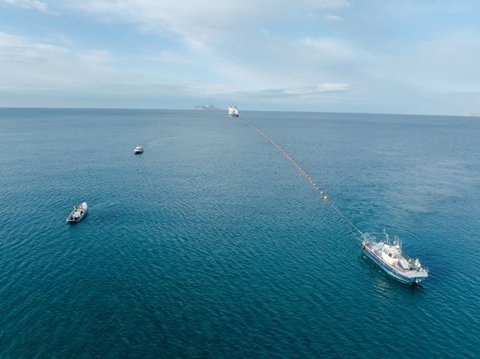
- New 340-kilometre subsea cable capable of supporting the equivalent of 25 million video users at the same time.
- Positions Greece as key international connectivity hub and provide boost to local economy.
- Allows Vodafone wholesale division to offer greater capacity and resilience to other providers.
Vodafone’s Carrier Services unit will construct a fast, high-capacity subsea optical fibre cable system in Greece, linking Crete with the mainland, to boost the local digital economy and improve access to vital online services such as healthcare, education and banking.
Vodafone is also building three new high-speed land-based cable systems which together with the subsea route will help position Greece as a major link in Europe’s digital corridor to other continents. They will boost internet connectivity for individuals and businesses throughout the country and provide other operators and internet service providers (ISPs) with enhanced resilience and greater capacity on a wholesale basis.
Work has started on the new subsea fibre cable, called the Thetis Express, with the marine survey already underway. The entire system will comprise two marine segments of 129 and 163 kilometres, plus terrestrial connections across the island of Milos and the end points on Crete and in Athens.
Once commercially operational, the Thetis Express will be around 340 kilometres in total and connect carrier neutral data centres in both Heraklion, Crete, and Attika, Athens. It will be capable of transmitting up to 180 terabits of data per second – the equivalent of approximately 25 million users streaming 4K video at the same time.
Fanan Henriques, Product and International Business Director, Vodafone Business, said: “Vodafone plays a central role in ensuring Internet traffic flows smoothly and securely worldwide. We are now extending this capability to more places in Greece using a mix of new optical fibre terrestrial and subsea cables, and in the future, emerging satellite services like space-based direct-to-device mobile broadband.”
The Thetis Express, together with the complementary terrestrial wholesale routes, will offer third-party providers a wider range of wholesale interconnectivity services to and from Greece to the rest of Europe, as well as Southeast Asia. Wholesale and retail customers will benefit from the ability to quickly switch traffic in the event of a cable break or power failure, alongside quicker interconnection across wide areas – including at a local level – when accessing online services, transmitting data or joining video conferencing calls.
Plans involve linking the Thetis Express to the expansive 2Africa cable network, which is already connected at Vodafone’s landing station in Crete and will ultimately connect 33 countries throughout Africa, Europe, and Asia. Vodafone Greece already operates an extensive subsea and terrestrial network infrastructure in the Aegean and Ionian Seas. These connect Attica with the Cyclades islands (Syros, Tinos, Mykonos, Naxos, Paros and Santorini), the Dodecanese (Kos and Rhodes) and Crete, as well as linking Corfu with mainland Greece.
Want to know more?
Learn about the history of subsea cables and their importance to today’s international data traffic in our subsea cable explainer video.
Read an interview with Rick Perry OBE, Head of Vodafone’s Subsea Partnerships.
Visit Connecting Continents – Vodafone for more information and news on subsea networks, as well as satellite connectivity.
More stories


Vodafone launches Express Capacity to quickly meet demand for data centre connectivity
3 minute read