


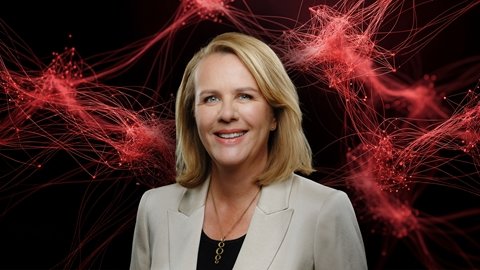
By Marika Auramo, CEO, Vodafone Business
Today, every business depends on connectivity. But the real opportunity is no longer just staying connected, it’s what connectivity makes possible.
In a world defined by data, distributed workforces and rapid technological change, businesses no longer value connectivity solely for keeping the internet running and phones ringing. They expect it to drive performance.
Paired with digital services, connectivity becomes something more powerful: a secure foundation that helps businesses of all sizes work smarter, move faster and grow with confidence.
Networks are the foundation for growth
We know our customers want more from connectivity – we hear it from them every day. Their technology environments are more complex, more distributed and more data-intensive than ever before. Applications sit across multiple clouds. Employees work across locations. Devices and sensors generate constant streams of data.
At the same time, AI is rapidly reshaping how businesses and their employees operate. From real-time analytics to automated decision-making, AI-driven processes depend on the reliable movement of data across systems and locations, at a scale never seen before.
Unlocking the power of connectivity is now business critical
To succeed in this environment, connectivity needs to do more. Embedding intelligence into the network and building systems that adapt, respond and optimise instantly.
This shift is already taking shape in five key ways:

1. AI-driven networks and automation
Modern networks do more than carry data, they can understand and act on it instantly.With Kompress.ai by Lantronix, Vodafone IoT connectivity is helping turn real-time data into action – optimising performance, automating compliance, reducing energy use and transforming how industrial equipment is managed.
At scale, this means organisations can anticipate demand, resolve issues early and operate with greater resilience, freeing up teams to focus on innovation.

2. Secure connectivity improves productivity
Security can no longer be an add-on. It needs to be built-in from the start. As networks become more intelligent and distributed, connectivity and security are coming together in new ways. Models such as Mobile Private Networks (MPNs) help bring access, performance and risk management together in real time. That gives organisations the confidence to innovate, whether deploying AI, enabling hybrid work or expanding into new markets.
Leading global electric vehicle manufacturer, Geely, has, for example, worked with Vodafone Business to create a secure connected ecosystem across multiple sites in Europe. This includes connecting offices and sales locations as well as inside the vehicles themselves, enabling Geely to continuously improve the driving experience for customers.
Ultimately, it’s this combination of intelligent connectivity and built-in security that turns data into action and helps businesses thrive.

3. Managed services for a digital world
Managed services can ease the operational burden while maintaining flexibility and control, keeping digital ecosystems agile, scalable and fit for the future.
Take an organisation like German law firm Görg Rechtsanwälte that provides comprehensive legal and tax advisory services to corporates, investors, financial institutions and the public sector. Operating in a highly regulated industry, our managed services have helped the law firm migrate to a secure cloud environment, enabling greater flexibility and fit for future deployments including the use of AI and data labelling.
It’s proof that as technology becomes more complex, the role of a trusted partner with deep technical expertise is critical, especially when delivering better service in a digital-first environment.

4. IoT and edge computing at scale
Healthcare is one industry you might not expect to operate at this scale. Yuwell is a leading medical equipment manufacturer, providing medical devices and homecare patient monitoring that uses cellular connectivity.
IoT-connected medical devices continuously monitor conditions like diabetes and sleep apnoea seamlessly, enabling clinicians to monitor patient progress and provide care instantly based on data feeds. The Managed IoT Connectivity Platform.
5. Real-time insights across operations
Data only matters if it drives action. Intelligent connectivity gives organisations real-time visibility across operations, enabling faster, better decisions.
From supply chains to customer experiences, it helps businesses to anticipate change, respond in the moment and continuously improve.
In logistics, real-time tracking powered by IoT is giving businesses end-to-end visibility of their operations, helping them respond faster, make better decisions and deliver a better customer experience.
Bringing it all together to reduce complexity
The opportunity is clear; the challenge is complexity. Years of technology investments, multiple providers and fragmented systems can create an environment that’s difficult to manage and slow to evolve. To be smart, business leaders don’t need more tools, they need simplicity.This is where trusted partnerships matter most. The right partner can help organisations bring together connectivity, digital services, and a secure cloud environment, together into a single ecosystem, reducing that complexity and improving return on investment. That is why we work with our customers to design and deliver connectivity architectures that not only enable intelligence, but are secure, scalable and easy to manage.
The future of connectivity is not just faster or more widespread. The businesses that will lead tomorrow won’t simply be online, they’ll use their networks to think, adapt and act in real time. That is what turns connectivity into intelligence.
Want to know more?
- Discover how Vodafone is powering our digital future
- Read more about how Vodafone Business works with Geely Technology Europe
- Explore our global leading IoT network
More stories


Vodafone launches Express Capacity to quickly meet demand for data centre connectivity
3 minute read