


Innovation has always been a part of Vodafone’s history. From the early days of mobile connectivity to today’s breakthroughs in Direct to Device satellite communications. We’re continuing to evolve with the needs of our customers and the world around us.
But it isn’t just about the technology. It’s about the people behind every invention, patent and idea who are driven by curiosity and a passion for solving the problems that matter.
In our latest series, meet some of our people behind the innovations that are helping shape the future, one concept at a time.
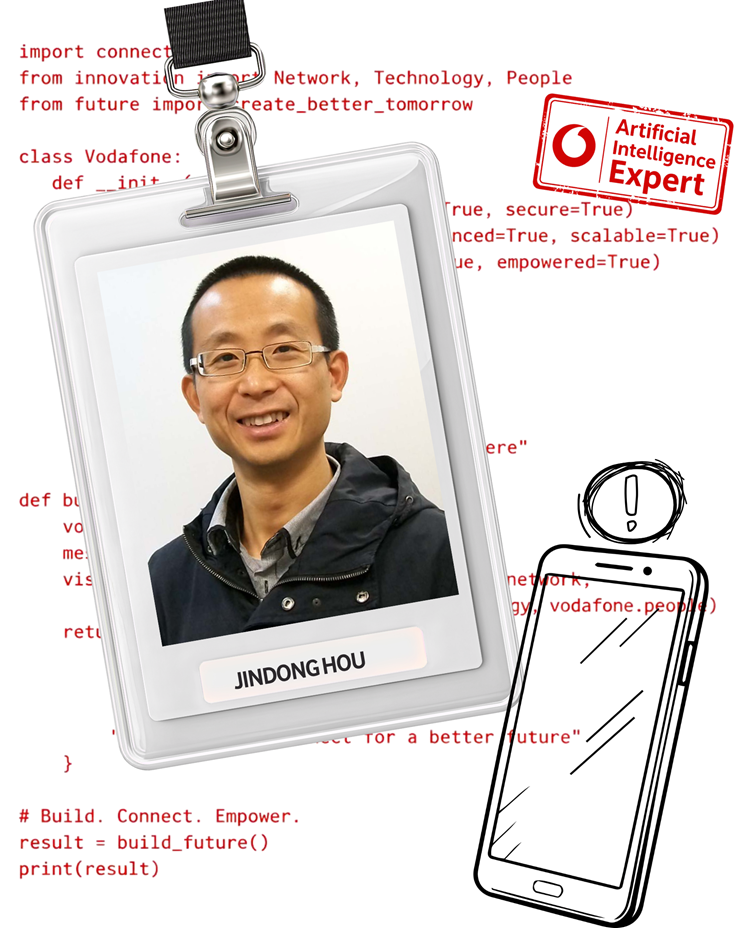
Jindong Hou, Lead Research & Innovation Architect at Vodafone Group
Can you tell everyone a little about yourself?
I lead AI research and innovation within Vodafone Group Technology, exploring how AI, data science and emerging technologies can solve real business problems and customer challenges. Over the years, I've been fortunate to author more than 30 patent filings covering subjects such as AI, machine learning, telecommunications and autonomous agents.
What excites me most is turning ideas into impact.
I love the moment when a concept moves from a whiteboard discussion to something that can influence products, networks or customer journeys. Knowing that an idea today could become a capability used by millions tomorrow is what keeps me curious and motivated every day.
What inspired your curiosity and creativity?
My curiosity was sparked during university when I first studied Data Structures and Algorithms. What fascinated me was the idea that complex real-world problems could be broken down into logical patterns and solved systematically.
That experience was the starting point of my journey into data science, computer application in telecommunications and eventually AI. More broadly, it taught me to approach challenges with a balance of curiosity and evidence, starting with data, asking questions and exploring possibilities rather than relying on assumptions.
"How can we use technology to solve problems to benefit more people in smarter ways?"
Thinking about one idea, was there a problem were you trying to solve?
Many of my inventions share a common theme: using advanced technology to solve business pain points. Some focus on "using AI to safeguard AI," such as detecting scam calls, and AI-generated network traffic. Others explore how Generative AI and autonomous agents can transform customer experiences and network operations.
For my most recent project we asked
the simple but profound question: what happens when AI agents become customers?
Today's products and systems are designed for people to browse, compare and purchase. Tomorrow, intelligent agents may perform many of these tasks autonomously. That sparked our work on our Agentic Commerce initiative, where were creating trusted, secure and telco-grade commerce experiences for AI-driven interactions.
My goal is always to create innovations that deliver practical benefits for customers, colleagues and society.
What was the biggest challenge you faced?
The biggest challenge we faced on this project wasn’t the technology itself but understanding how AI agents could participate in real commercial processes. We adopted a highly collaborative approach, working closely with Vodafone Business to understand real customer journeys and with colleagues from the cybersecurity and architecture teams to ensure, security and governance were built in from the start.
That experience reinforced an important lesson:
breakthrough innovation rarely comes from technology alone. It happens when different expertise
comes together around a shared problem.
Looking ahead, what excites you most about the future of innovation at Vodafone?
Vodafone has innovation in its DNA.
What excites me most is that innovation here isn't treated as a side activity. It’s part of how we think, collaborate and solve problems on a daily basis.One of the biggest misconceptions about innovation is that you need a fully formed idea before you begin. Most great innovations start as half-formed thoughts, questions or observations. I'm especially excited about the opportunity to combine trusted connectivity with AI-driven services and agent-based ecosystems. The next wave of innovation won't just improve existing products, it will redefine how people, businesses and machines interact.
Finally, what advice would you give to someone who has an idea but isn't sure where to start?
My advice is simple: take the first step. Talk to people, test your assumptions, sketch your idea on paper and ask questions. Every conversation will help refine your thinking and uncover new possibilities.
Innovation is a journey of learning, not a process
of having all the answers upfront.
Don't wait for the perfect moment. There isn't one!
Quote Icon
Ultimately, it's about making technology work better for people
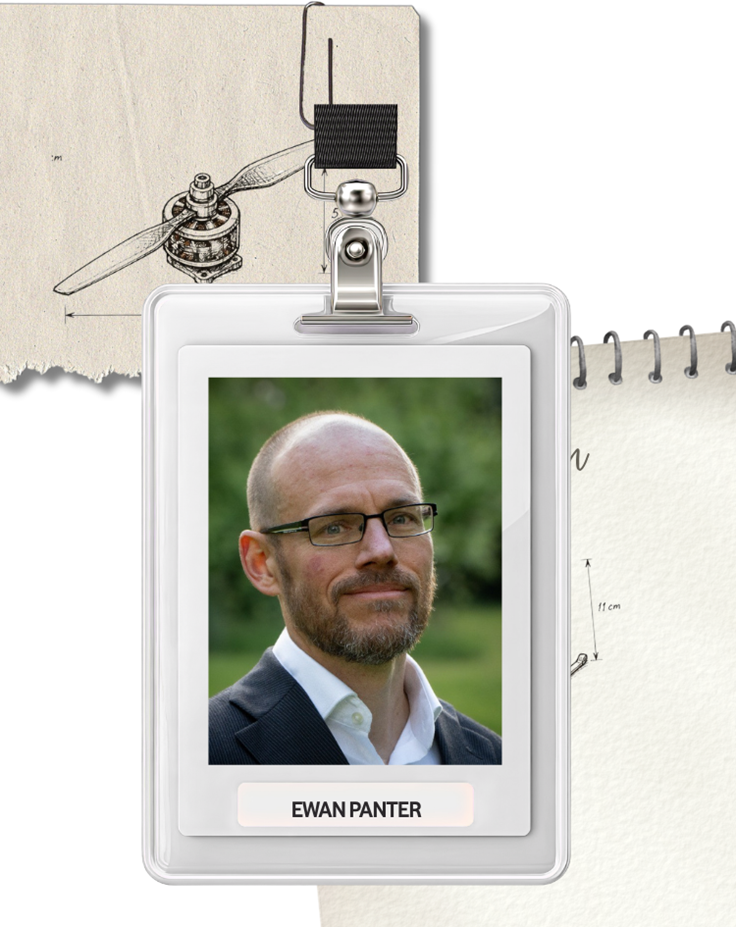
Ewan Panter, Senior Manager, AI & Data, Business Transformation at VodafoneThree
Can you tell everyone a little about yourself?
I'm responsible for AI and Data across Vodafone Business Technology Solutions at VodafoneThree, helping shape how we use AI, from strategy through to systems that are live in production today. AI is evolving at an extraordinary rate, making this one of the most exciting and energetic fields to be part of.
Alongside this, I'm part of a team participating in this year's global innovation competition, working with colleagues from different areas of the business to turn innovative ideas into practical solutions in a short space of time.
What inspired your curiosity and creativity?
When I was young, I was obsessed with taking things apart with screwdrivers, something my dad would enthusiastically encourage. Now that I’m a parent myself, I realise it was quite the brave decision to let your child pull apart a perfectly good piece of electronics!
I also loved drawing cut away pictures of jets, submarines, and anything mechanical, I was alone at my senior school in already understanding how a submarine’s pressurised water nuclear reactor worked as I’d been drawing them since age 8.
Thinking about one idea, was there a problem were you trying to solve?
For this year’s innovation challenge our team knew we wanted to focus on a concept that had real world impact on communities that needed it the most and explore how drone technology could address new challenges.
I’d come across the Vodafone Foundation Instant Network Emergency Response (INER) team and the work they do to restore vital connectivity during humanitarian crises, and that, combined with our interest in drone technology led us to try and conceptualise the Sky-Fi system.
The result, in simple terms, a drone that carries an INER Wi-Fi access point powered continuously from the ground. Flying 30m above obstacles, it extends coverage, improves reliability and helps connect people when they need it most.
What was the biggest challenge you faced?
There were numerous challenges we had to think hard about during the design process. As we developed the idea, we realised that regulatory issues would be just as big of a hurdle as the hardware side.
The first hurdle was that the drone needs to be powerful enough to stay airborne in strong winds. Increasing power isn’t straightforward - a thicker tether adds more weight, creating a cycle where solving one issue creates another.
Every decision involves a complex compromise and judgement call.
A completely different challenge was the fact drones are regulated differently in every region. Combined with the emergency nature of these INER deployments, this means we need to get ahead of the regulatory approval process as much as possible, to ensure the system can be deployed quickly when it is needed.
Looking ahead, what excites you most about the future of innovation at Vodafone?
What I like most about Vodafone’s approach to innovation challenges is that it’s not just about making a cool proof of concept; it’s about developing a solution we can bring to production and which can make a difference.
We are integrating increasingly powerful AI into how we work, creating new opportunities for innovation. This also brings real challenges, particularly around using these technologies responsibly, but solving those kinds of complex problems is what Vodafone does best.
I’ve always been impressed by the spirit of innovation here; colleagues and leadership genuinely support our innovation initiatives.
Finally, what advice would you give to someone who has an idea but isn't sure where to start?
Nothing happens if you don’t do something about it.
Your best bet is just to email someone. In my experience people are normally keen to help and happy to point you in the correct direction.
Quote Icon
I’m excited most by the speed of innovation. Ideas that felt like science fiction five years ago are now becoming reality.
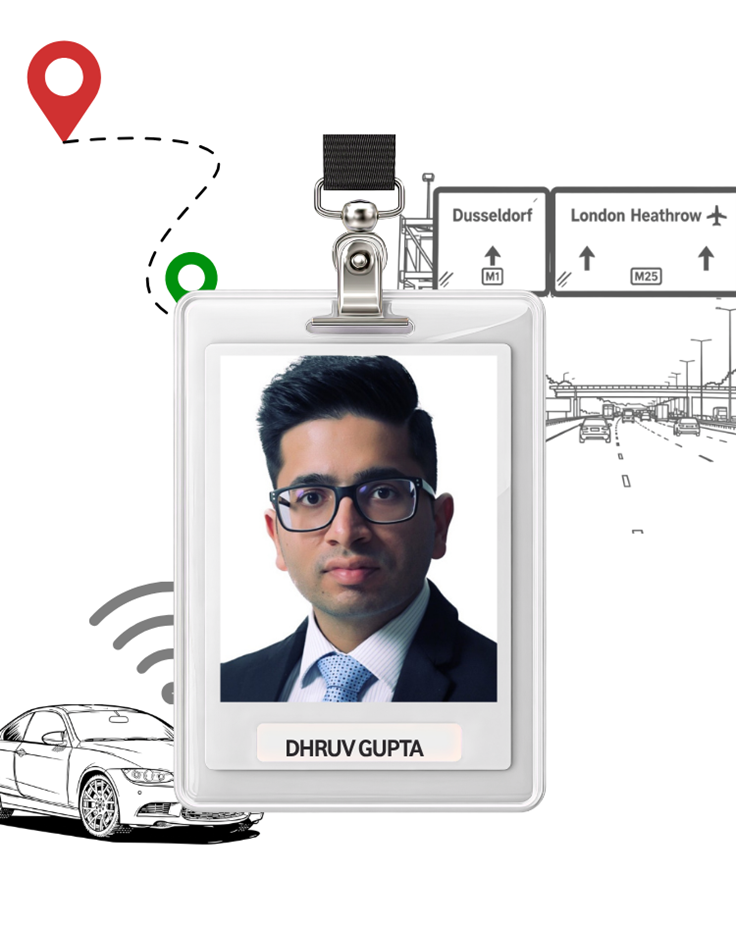
Dhruv Gupta, IoT Product Manager – Connected Cars at Vodafone IoT
Can you tell everyone a little about yourself?
I'm a Product Manager for Car Connectivity, working with automotive manufacturers to bridge the world of connected vehicles with Vodafone's connectivity capabilities. I focus on Internet in the Car (IITC), which enables secure, regulatory-compliant internet access for drivers and passengers, from in-car browsing and Microsoft Teams calls to Wi-Fi for families on the move.
What excites me most is that we're at the start of a major transformation. As connected cars become the norm and the industry evolves towards AI-defined vehicles, the network becomes ever more critical.
Being part of that journey and helping shape what comes next is what makes my role so rewarding.
What inspired your curiosity and creativity?
Growing up in suburban India, I was always curious about how things worked, so becoming an engineer felt like a natural path.
When I started my career in the automotive industry, cars were evolving from mechanical machines into software platforms. The launch of vehicles like the Tesla Model S challenged long-held assumptions and demonstrated how software could redefine the driving experience.
Looking back, that mindset of continuous learning has shaped the way I approach innovation ever since.
Thinking about one idea, what problem were you trying to solve?
Before joining Vodafone, I'd spent almost a decade in the automotive industry, so I arrived with the perspective of a vehicle manufacturer rather than a telecommunications engineer.
As I learned more about Vodafone's capabilities, I realised the automotive and telecom industries often view the same challenges from different angles. Connectivity is frequently treated as a background utility, meaning the full potential of the network is underused.
That sparked a question I still ask today: why not let the network do more?
Could we use the intelligence already built into it to make vehicles smarter, reduce complexity for manufacturers, and create solutions that are more secure, scalable and easier to deploy? For me, the opportunity was to move connectivity from a passive utility to an active part of the vehicle experience.
What was the biggest challenge you faced?
The biggest challenge wasn't the technology, it was bringing together people from different disciplines. Throughout my career I've often been the "odd one out": a mechanical engineer in a software organisation, a software engineer in an AI environment, and now an automotive specialist in a telecommunications company.
I've learned that keeping the customer and the problem at the centre of every conversation creates alignment. Once people focus on the challenge rather than their differences, the best ideas emerge.
Innovation isn't just about having a good idea. It's about bringing together people with different expertise, building a shared understanding, and turning ideas into something that delivers real value.
Looking ahead, what excites you most about the future of innovation at Vodafone?
We're seeing fundamental shifts across multiple technologies at the same time. AI, connectivity, satellites, edge computing and AI-defined vehicles are no longer evolving independently, they're beginning to converge.
That's what excites me most about Vodafone.
We're in a unique position to bring these worlds together and help shape what comes next.
What advice would you give to someone who has an idea but isn't sure where to start?
Start by asking why before you ask how. Focus on solving a real problem rather than whether the idea is technically possible.
My first inventions didn't start as complete solutions; they started as observations. Talk to people, use tools like Copilot as a brainstorming partner, get feedback early and keep refining your thinking.
And finally, just submit it.
No idea is perfect on day one. Once it's out there, it can evolve through collaboration, conversation and new
perspectives.
Quote Icon
We’re moving towards a future where the boundaries between communications, computing and intelligence become far less distinct. Whatever we choose to call that future, I'm excited to help shape it.
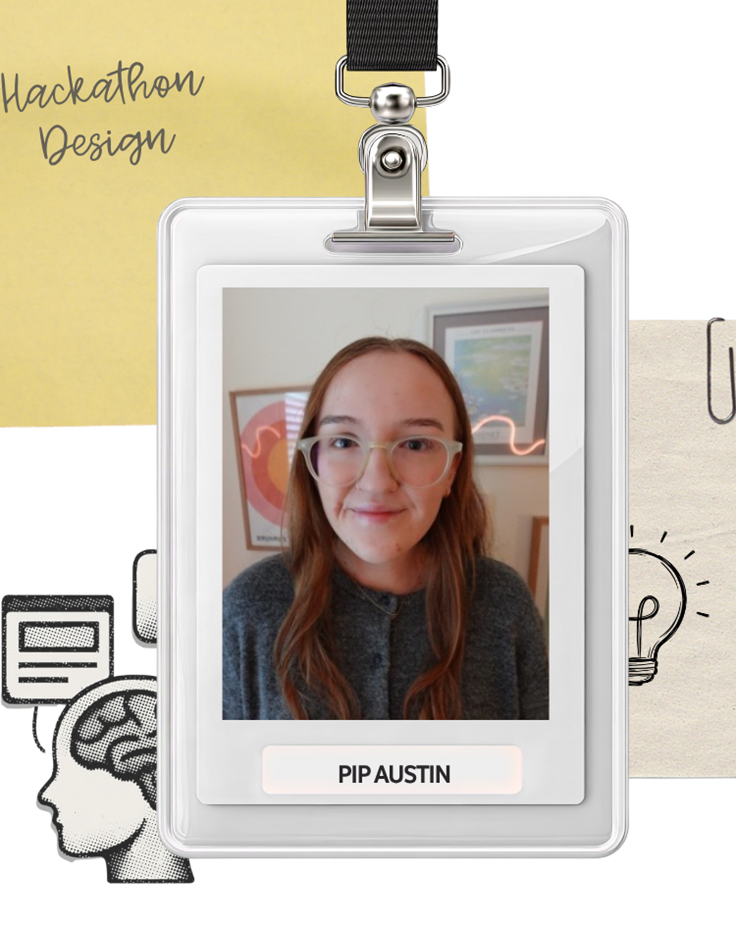
Pip Austin, Lead IoT Engineer Emerging Technology at Vodafone IoT
Can you tell everyone a little about yourself?
I'm the Lead Engineer for AI & Emerging Technologies within Vodafone IoT. Currently I’m focused on exploring how we can use technologies like Generative AI to create real value for both customers and colleagues. It’s a very exciting space to be working in, with new possibilities emerging all the time.
I enjoy combining the challenge of building innovative solutions with helping others learn along the way.
Beyond my day-to-day role, I’m part of a team participating in this year's global innovation competition, where I have the opportunity to collaborate with colleagues and explore latest technologies. These events are great for brainstorming new ideas, learning from each other, and building solutions that can really have an impact.
What inspired your curiosity and creativity?
Creativity played a huge role in my life growing up. Surprisingly, my background is in art rather than technology, and I didn’t study computing or software engineering until I joined Vodafone through the apprenticeship programme.
Looking back, that creative foundation shaped how I approach problem solving today.
As a child, my projects often left quite a mess, but my parents always encouraged me to explore new ideas and never halted my creative endeavours.
Thinking about one idea, was there a problem were you trying to solve?
In last year’s innovation challenge, our team developed a visual intelligence monitoring system designed to act as an extra pair of eyes for monitoring. Something everyone can benefit from. Using AI-powered vision technology, we created a prototype that could understand what it was seeing and automatically flag situations that required attention.
While our detailed business case focused on sewage outfalls, you can imagine the potential uses far beyond this sector.
It’s a great example of how emerging technologies can unlock new possibilities and create
meaningful benefits for our customers, businesses and colleagues.
What was the biggest challenge you faced?
What excited us most about the project was also one of the hardest decisions to make. The technology had the potential to be used across a wide range of industries and scenarios -
every conversation seemed to uncover another opportunity .
Whilst having such a widely applicable solution is great, finding a use case that aligned with the evolving AI regulations was more difficult.
Ultimately, we chose to build our business case around sewage outfall monitoring. It provided a practical, lower-risk application and demonstrated how the technologies could help tackle important environmental challenges. Something that is surprisingly difficult to get right!
Looking ahead, what excites you most about the future of innovation at Vodafone?
Vodafone drives a culture of innovation, where curiosity and experimentation is encouraged
It’s one of my favourite things about working here! Events such as our global innovation challenge give us the opportunity to step back from our everyday priorities, collaborate with others and bring new ideas to life.
Finally, what advice would you give to someone who has an idea but isn't sure where to start?
Brainstorm! I have thousands of notes on my phone filled with thoughts and ideas
I may one day find useful. Whether it’s through conversations with colleagues or using AI as a sounding board, finding ways to test and develop your ideas is incredibly valuable.
I would also highly recommend getting involved in initiatives like our innovation challenge. In my experience these events can be a powerful way to turn ideas into reality.
Quote Icon
If an opportunity feels daunting, do it scared, do it anyway.
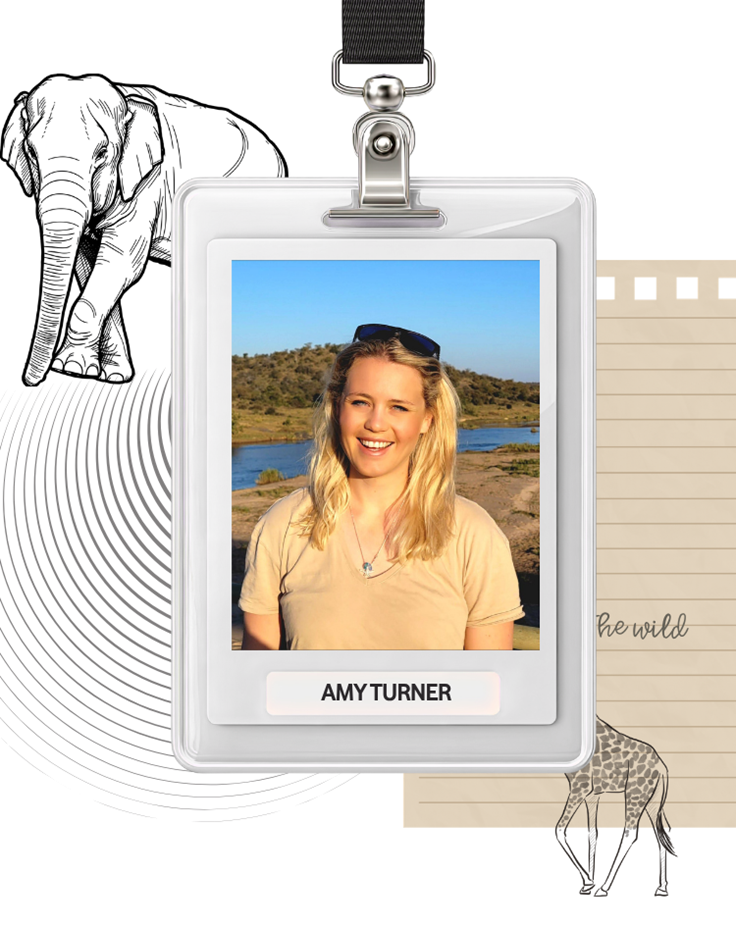
Amy Turner, Senior Demand and Transition Lead at VodafoneThree
Can you tell everyone a little about yourself?
I joined Vodafone at the end of 2019 as a Business Operations graduate, after spending six or seven years as a Team GB Kayaker and completing a Master’s in Psychology. During my time at Vodafone, I’ve also been part of the UN Global Compact Innovators Programme and co-founded Youth Connect, a global graduate network connecting graduates across Vodafone’s operating countries. Today, I’m a Senior Operational Manager in Enhanced Service, leading our newly formed Demand and Transition team.
I love the variety, the teamwork, the problem-solving and, most importantly, seeing the impact we can have on some of our largest and most complex business customers.
What inspired your curiosity and creativity?
Sport and the outdoors have always been a huge part of my life. Growing up, I did everything from swimming and horse riding to athletics, cycling and triathlon, before eventually competing in sprint kayaking.
always looking for a different way, learning from other people and asking, “Could we do this better?”
Thinking about one idea, what problem were you trying to solve?
Outside work, I’ve always been passionate about wildlife conservation, particularly in Africa, and through travelling and supporting conservation organisations I kept hearing about the growing challenge of human-wildlife conflict. It made me ask: how can people and wildlife coexist when they increasingly have to share the same space and resources? When I joined Vodafone and discovered our IoT capabilities, I realised some of our existing technology could potentially be repurposed to help.
That simple connection between a problem I cared about and technology we already had sparked the idea.
The result – bringing IoT to the wild.
What was the biggest challenge you faced?
One of the biggest challenges was making people understand why a problem happening thousands of miles away should matter to us. Visiting affected communities and bringing their stories back helped make the issue real.
Ultimately, if technology can help communities protect themselves, their families and their livelihoods from potentially dangerous wildlife, coexistence becomes much more achievable. In turn, wildlife has a better chance of being protected. It also demonstrates to our colleagues and customers what using technology for good can really mean. Applying Vodafone’s capabilities to real-world challenges and creating positive outcomes for both people and the planet.
The other big challenge…
taking sophisticated technology and making it intuitive enough to work for the communities who actually need it.
Making something simple is really hard!
Looking ahead, what excited you most about the future of innovation at Vodafone?
Vodafone has an incredible opportunity to use its technology and scale to help
tackle some of the world’s biggest challenges.
This project started by taking an existing IoT capability and asking, “What else could this do?” That’s what excites me about innovation.
For every technology we develop, we should be thinking beyond its original purpose – could it support a community, a not-for-profit use case or solve a completely different problem?
What advice would you give to someone who has an idea but isn't sure where to start?
Fail fast. Fail forward and find a way.
Quote Icon
We already have incredible capabilities; the exciting part is finding new and unexpected ways to use them for good.
Want to know more?
Our Head of R&D talks about why agility, collaboration and a licence to disrupt are essential to building what comes next.
Learn more about our R&D work.
More stories

Vodafone launches Express Capacity to quickly meet demand for data centre connectivity
3 minute read

Vodafone and its partners demonstrate how users can improve fibre broadband for key applications
3 minute read

Joint field trial shows how modern mobile networks support live television production
3 minute read